Local MCP Without the Myths: What Stays on Your PC and What Can Go Online
Local stdio describes how an MCP client talks to the host, but it does not guarantee a fully local AI process. This guide maps the complete data path and practical security boundaries.
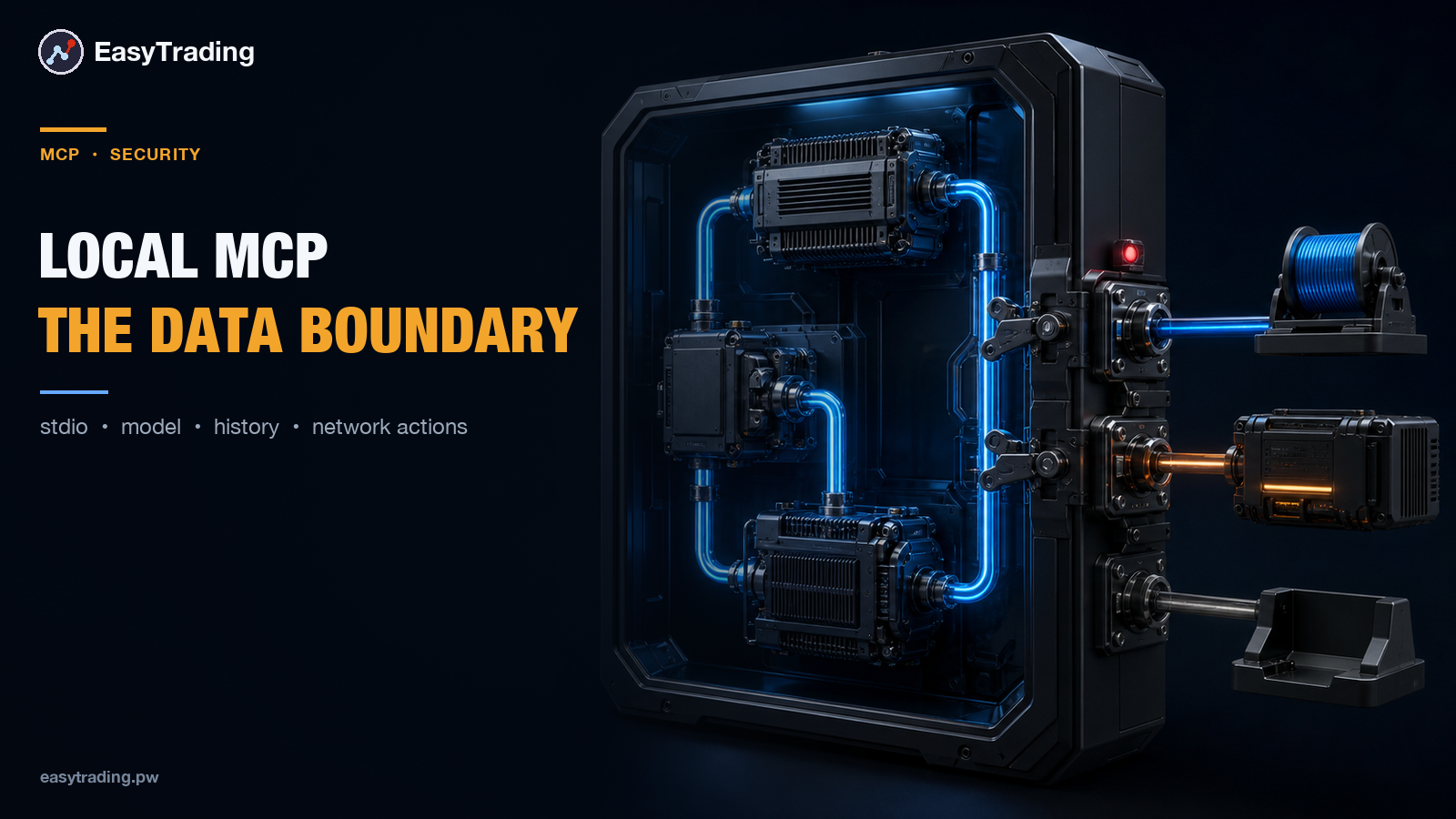
An MCP server is described as “local stdio.” Does that mean strategy code, market history and results can never leave the computer?
No. That phrase describes one part of the architecture: how the MCP client communicates with the host. It does not determine where the language model runs, how the client stores requests or which additional functions use the network.
Security needs to be evaluated across the complete data path, not from the word “local” alone.
Three different meanings of “local”
Discussions about AI tools often mix three separate ideas.
1. Local transport
The client starts an MCP host on the same computer and exchanges messages through stdio. No separate MCP network port is opened.
This is how XTester MCP operates.
2. A local application process
XTester and its MCP host run on the user’s computer. Projects, downloaded history and results can be stored locally.
The application may still perform specific network actions—for example, downloading market history, accessing GitHub or checking for updates.
3. A local model
The language model also runs on-device and does not send requests to a cloud provider.
That is a property of the AI client and selected model, not of XTester’s MCP transport. If Claude, Codex or another client calls a cloud model, part of the working context may be processed by that provider.
The distinction can be summarized in one rule:
Local MCP transport does not equal a fully local AI process.
What the AI client may see
To perform a task, the MCP client receives structured descriptions of available capabilities and the results of calls. Depending on the client and configuration, model context may include:
- tool names and schemas;
- call arguments;
- results and errors;
- source-code fragments;
- project names and paths;
- compilation and execution logs;
- metrics, trades and market-data fragments.
This does not mean every client always sends every item. The actual scope depends on the request, client implementation, selected model and retention settings. A careful security assessment should nevertheless assume that information shown to a cloud-backed agent may be processed by its provider.
Where the network can still appear
Network traffic can be a normal part of the task even when MCP uses local stdio.
| Action | Why network access is used | Potential data |
|---|---|---|
| Cloud model request | Agent reasoning and generation | prompt, schemas, arguments, results, code and logs included in context |
| History download | Obtain market data | venue, instrument and date range |
| GitHub operation | Versions, repository or releases | code and metadata within the confirmed operation |
| Update check | Identify and obtain a release | application version and request to the update source |
| Telemetry | Diagnostics after consent | only data covered by the selected settings and report |
The useful question is not “is there any network traffic?” It is: which action uses the network, what does it transmit, and who approved it?
A practical checklist before connecting an agent
Download from the official source
For XTester, use the official GitHub Releases page. Avoid repackaged installers, random archives and debug builds copied from third-party instructions. Do not disable SmartScreen or antivirus controls just to make an installation proceed.
Use the built-in connection screen
XTester knows the actual location of components in the installed release. Its connection screen prepares configuration for the selected MCP client and reduces the chance of copying another user’s path or a stale command.
Start with a read-only check
The first call should confirm connectivity and environment identity, not mutate a project, download a large range or perform a remote write.
Before files change, the agent should expose the workspace and project it intends to use: path, name and expected structure.
Keep secrets outside the agent path
API keys, passwords, seed phrases and private keys should not appear in prompts, strategy files, compiler logs or support reports.
An MCP server for historical backtesting does not need a private trading-account key. If an instruction requests one without a clear reason and separate permission model, stop.
Inspect the AI client’s data policy
Before sharing a private strategy, establish:
- which model is being used;
- whether requests go to a cloud provider;
- whether prompts and tool results are retained;
- whether data is used for training;
- whether retention can be disabled or a local model selected;
- which logs remain on the computer.
Minimize scope
The agent rarely needs the entire repository, full history and complete logs at once. Expose the smallest project and date range sufficient for the current task. Smaller context reduces both risk and processing cost.
Separate reading from mutation
A useful impact ladder is:
- inspect the environment;
- read a project and results;
- change local files;
- download data;
- write to an external service;
- install an update.
The greater the impact, the more specific the confirmation should be: what will change, where, and how the previous state can be restored.
Preserve a rollback path
Before agent-driven changes, keep the strategy in Git or create a backup. Each result should point to the exact source version. That makes an error reversible rather than merely observable.
What XTester states publicly
XTester’s public documentation establishes these boundaries:
- MCP transport uses local
stdio; - no separate network MCP listener is opened;
- installing and launching the application remain user-confirmed actions;
- a read-only connectivity check is recommended first;
- XTester telemetry is described as optional and consent-based;
- separate network actions may exist for history, GitHub, AI providers and updates;
- live trading through the public MCP interface is not claimed.
The site deliberately does not promise that data “never leaves the device.” Such a claim would require end-to-end verification of the specific MCP client, model, provider and configuration.
Security is not a ban on automation
The goal is not to confirm every harmless read by hand. Good automation starts with bounded authority and visible boundaries.
A reasonable default for strategy research is:
- a local project;
- a read-only start;
- an explicit workspace;
- minimal context;
- a fixed historical range;
- separate confirmation for mutating and network actions;
- a saved version before changes;
- a report of what the agent read, changed and produced.
That keeps MCP useful as an agent interface without giving up control over code, data and actions.
References
XTester is designed for strategy development and historical testing. Backtests do not guarantee future returns and are not investment advice.